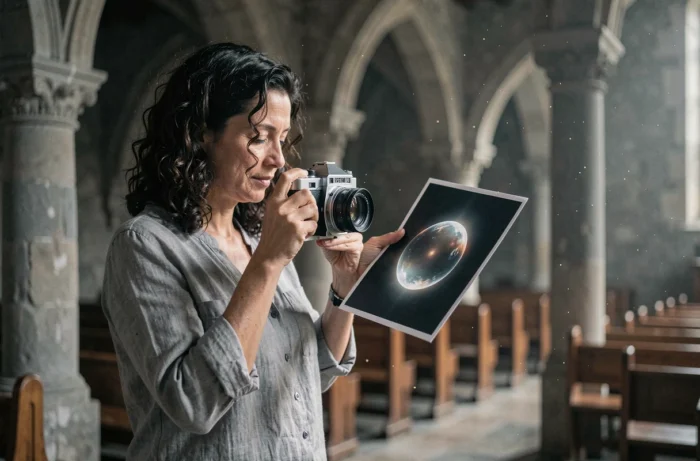
Have you ever flipped through your vacation photos and noticed a glowing sphere floating in the image, with no apparent explanation? These circular shapes, called orbs, have fueled debates since the rise of digital photography. Between a well-documented optical artifact and a phenomenon that some associate with the paranormal, orbs deserve a methodical examination.
Why a single photo of an orb is never enough to draw conclusions
Most discussions about orbs revolve around the image itself: its color, transparency, shape. This is a starting point, but a single photo does not allow for a definitive conclusion. To seriously evaluate a luminous anomaly, multiple elements must be gathered.
- The original file, uncompressed by messaging or social media, retains the details that platforms remove during sharing.
- Images taken just before and after the suspicious photo help determine if the anomaly persists or disappears, which points to a material cause (dust on the lens, for example).
- The shooting conditions – flash on, low light, ambient humidity – explain the majority of common cases.
- EXIF metadata (shutter speed, ISO sensitivity, flash usage) provides clues, but they can be deleted or modified; thus, they do not constitute proof on their own.
Without this collection of information, attributing a specific cause to an orb is more a matter of speculation than analysis. Those who wish to understand the meaning of orbs benefit from starting with this sorting work before any interpretation.
Orbs and photographic artifacts: concrete optical causes

When a speck of dust, a droplet of water, or an insect passes very close to the lens, it ends up outside the depth of field. The sensor then records a blurry, circular spot, sometimes translucent. This is the most common mechanism.
The flash exacerbates this phenomenon. Its light strikes the suspended particles and makes them shine disproportionately compared to their actual size. The result: a dust particle of a few microns produces a luminous disk that appears to float away from the photographer.
Infrared cameras and surveillance systems pose an additional problem. They make visible particles or small insects that the naked eye cannot perceive in the dark. The apparent shape and movement depend on the image processing specific to each device, the camera’s position, and the focal length. A video alone is not enough to establish the actual distance or trajectory of what appears on the screen.
Have you ever seen dozens of orbs in a photo taken in the rain? This is a classic case. Each droplet near the lens generates its own luminous circle. Indoors, a simple draft that stirs up dust produces the same effect.
Reproducible tests to distinguish an orb from an artifact
Rather than debating from a single image, a more reliable approach is to attempt to reproduce the phenomenon. This is the simplest method to rule out mundane causes.
Take several photos of the same location, under the same conditions, varying only one parameter at a time: with and without flash, after airing out the room, cleaning the lens between each shot. If the orb disappears when the flash is turned off or when the dust settles, the material cause is very likely.
Conversely, if the anomaly persists despite controlled conditions, the phenomenon becomes more difficult to explain solely by optics. It is this type of result that interests investigators, whether they are skeptical or open to paranormal hypotheses.
A detail often overlooked: compare the results obtained with two different devices at the same time. If the orb appears on only one of the two, the problem likely lies with the device. If it appears on both, the question remains open.

Spiritual and paranormal interpretations of orbs
Once the optical causes are ruled out (or at least examined), some observers associate orbs with spiritual phenomena. In this interpretation, orbs would be manifestations of energy, sometimes linked to entities, nature spirits, or presences tied to a location.
The color of the orb is often interpreted as an indicator. White or golden spheres are generally associated with positive or protective energy. Blue hues would evoke a calming dimension. Dark or reddish orbs raise more caution among adherents of these interpretative frameworks.
Some locations seem to concentrate reports: sites considered sacred, ancient forests, historically significant buildings. People who practice meditation or energy rituals also report more frequent appearances. These correlations do not constitute proof, but they contribute to a body of testimonies that digital photography has made much more visible.
The key point to remember: no current method allows for the definitive validation or invalidation of the spiritual hypothesis. The phenomenon exists in a zone where photographic technique, particle physics, and personal beliefs intersect without resolving each other.
Orbs in photos: maintain a critical eye without closing the door
The temptation is strong to choose a side: explain everything by optics or attribute everything to the supernatural. Both positions have their limits. The vast majority of photographed orbs can be explained by suspended particles illuminated by the flash. Denying this technical reality amounts to ignoring decades of documentation on how digital sensors work.
But systematically reducing every testimony to a speck of dust also avoids a legitimate question: why do some anomalies resist reproduction tests? Intellectual honesty involves admitting that a portion of cases remains without satisfactory explanation, without jumping to a paranormal conclusion.
Before interpreting an orb captured in your photos, check the lens, test the flash, compare the shots. If after all this the phenomenon persists, feel free to explore other interpretative frameworks, keeping in mind that mystery is an integral part of the subject.