Ten village names, one grape variety (Gamay), and granite soils that change character every few kilometers: Beaujolais is often summarized by its November primeur, while its ten crus produce reds capable of aging and competing with much more prestigious appellations.
The following ranking is based on a simple criterion: the ability of each cru to surprise during tasting, whether one is a novice or a seasoned enthusiast. We prioritized the personality of the wine, its versatility at the table, and the interest of its terroir.
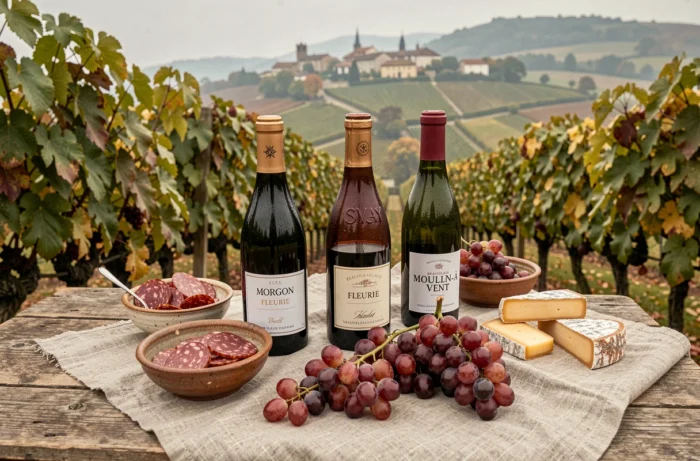
1. Morgon
When you open a bottle of Morgon from Côte du Py, you encounter a wine that does not match the typical idea of Beaujolais. The decomposed volcanic rock gives the wines a density and depth that sometimes recall the neighboring Burgundy. With a few years in the cellar, Morgon develops aromas of black cherry and flint that are unique to it.
It is also a versatile cru: it pairs well with both braised red meat and a platter of aged cheeses. To discover the ranking of the 10 crus of Beaujolais in detail, Morgon is a solid starting point because it illustrates what Gamay can produce best on granite.
2. Moulin-à-Vent
Sometimes referred to as the “lord of Beaujolais,” the tasting confirms this reputation. The manganese and iron oxide-rich subsoil marks the wines with an unusual tannic structure for Gamay. Some cuvées can last ten years or more without weakening.
At the table, Moulin-à-Vent is closer to a Pinot Noir from Côte de Beaune than to a classic Beaujolais. It is the cru to open when you want to convince a skeptic that Beaujolais produces serious wines for aging.
3. Fleurie
Fleurie holds a special place due to its immediate elegance. It features notes of iris, violet, and fresh red fruits that captivate from the first sniff. The pink granite of the hills produces fine wines, without heaviness, that remain digestible even in the height of summer.
It is the most accessible cru for a first discovery of the communal appellations of Beaujolais. Its finesse makes it an ideal companion for roasted poultry or grilled fish in a light sauce.
4. Côte de Brouilly
Where Brouilly sprawls at the foot of the hill, Côte de Brouilly climbs the slopes of Mont Brouilly with soils of blue volcanic rock (the “blue stone” or green horn). This geological peculiarity gives the wines a marked minerality and a tight grain on the palate.
Yields remain moderate on these steep slopes, and the concentration is noticeable. The wines are more tense and precise than those of Brouilly, with a potential for aging of a few years.
5. Chénas
The smallest of the ten crus in area, Chénas remains little known, which works in favor of the enthusiast: prices are still very reasonable for high quality. The wines combine the structure of Moulin-à-Vent (which it directly neighbors) with a generous fruitiness reminiscent of cherry and peony.
It is the cru to include in a blind tasting: it often destabilizes those who think they can identify a Beaujolais at first sniff.
6. Juliénas
Located in the northern part of the vineyard, Juliénas benefits from varied soils (granite, schist, and some clay) that produce wines that are both fruity and spicy. Depending on the parcels, one can transition from a soft and indulgent profile to a more structured wine, making it a cru to explore in depth.
Local tradition suggests pairing it with Lyonnaise charcuterie, and this advice works well: its liveliness cuts through the fat without overpowering the flavors.
7. Chiroubles
Chiroubles has the highest vineyards among the ten crus. This elevated position yields fresh, light, and immediately enjoyable wines, with aromas of violet and small red fruits. It is the quintessential thirst-quenching Beaujolais, served slightly chilled in summer.
Its airy profile does not mean it lacks substance: in a good vintage, Chiroubles reveals a floral complexity that deserves to be savored with attention rather than consumed mindlessly.
8. Saint-Amour
The northernmost of the Beaujolais crus, Saint-Amour marks the border with Mâconnais. Its wines tend toward roundness, with notes of sweet spices and ripe fruits. The name helps with identification, but it is primarily the consistent quality that distinguishes it.
It is often found on the menus of Lyonnaise bistros, served in a 46 cl pot. It is a convivial cru, meant to be shared without ceremony.
9. Brouilly
The most extensive cru in Beaujolais, Brouilly produces fruity and round wines that are easy to access. Its size implies a certain diversity of styles among producers, but the general profile remains that of a wine that is indulgent, focused on crunchy red fruit, ready to drink within two years.
- Ideal for an introduction: its direct fruitiness does not confuse anyone
- One of the best quality-price ratios in the Beaujolais vineyard
- Served slightly chilled, around 13-14 °C, to maintain its liveliness
10. Régnié
The last cru to obtain its communal appellation (in the late 1980s), Régnié remains the least known of the ten. This is precisely what makes it interesting: the winemakers work with particular energy to assert the identity of the cru. The wines offer a fruity, smooth profile, with hints of currant and raspberry.
For a vintage like 2024, marked by a rainy spring followed by a hot summer and a mild September, Régnié has been able to express preserved freshness while gaining in maturity. This type of contrasting vintage highlights the differences between lieux-dits, and Régnié is no exception.
Ten crus, ten personalities, but one common thread: Gamay on granite, crafted by winemakers who push the boundaries of a grape variety that has long been underestimated. The most useful approach is to open several side by side to measure the differences. Three bottles are enough to see that a Chiroubles and a Moulin-à-Vent have almost nothing in common, except for their region of origin.