
Expanding tight socks without distorting them requires understanding what each fiber can tolerate. Not all methods are suitable for every textile, and some socks will never gain a centimeter, no matter how much they soak. Before plunging your socks into a warm water bath, the useful question is: what result can you realistically expect, and when should you simply accept that the size does not fit?
Expanding socks by fiber: what each material can tolerate
The behavior of a sock when soaked depends almost entirely on its composition. A pair made of wool does not react at all like a pair made of synthetic fibers, and confusing them leads to disappointments or damage.
| Fiber | Reaction to warm soaking | Possible expansion | Main risk |
|---|---|---|---|
| Wool | The fibers relax well with a fabric softener or white vinegar | Moderate to good | Felting if the water is too hot or if there is friction |
| Cotton | Absorbs water, relaxes slightly | Low to moderate | Loses its shape after several cycles |
| Polyester / Nylon | Very low absorption | Almost none | The fiber returns to its original shape when drying |
| Elastane (blend) | Elastane resists permanent stretching | Very limited | Deformation of the knit without real comfort gain |
Wool socks are the only ones that respond well to home expansion. Their natural fiber has a scaly structure that, once relaxed by warm water and a softening agent, retains some of the stretch achieved.
In contrast, pairs with a high proportion of synthetic fibers or elastane almost systematically return to their original size after drying. If the label indicates more than half polyester or nylon, soaking will not change much.
Knowing how to relax tight socks therefore starts with reading the composition label before any manipulation.
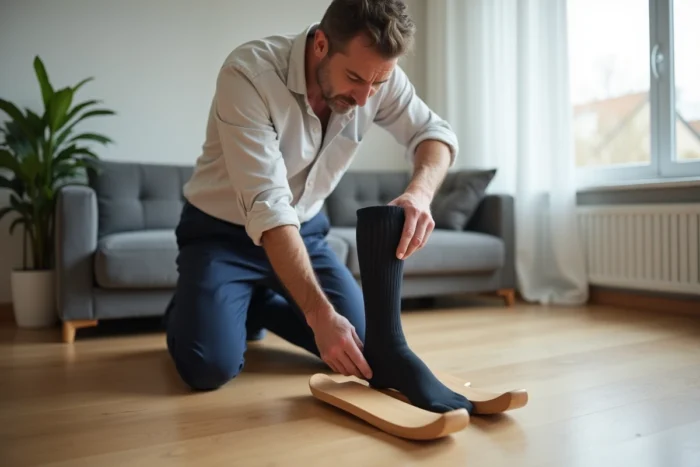
Warm water and softener method for expanding wool socks
This technique works on wool socks or those primarily made of natural fibers. It relies on the relaxation of fibers through hydration, without mechanical aggression.
- Fill a basin with warm water (never hot) and add a dose of fabric softener or a spoonful of white vinegar
- Immerse the socks for about twenty minutes, gently manipulating them from time to time, without rubbing
- Remove them, wring out without twisting, then gently stretch them widthwise and lengthwise
- Put them on a rigid support (bottle, paper towel roll, shoe tree) to maintain the shape while drying
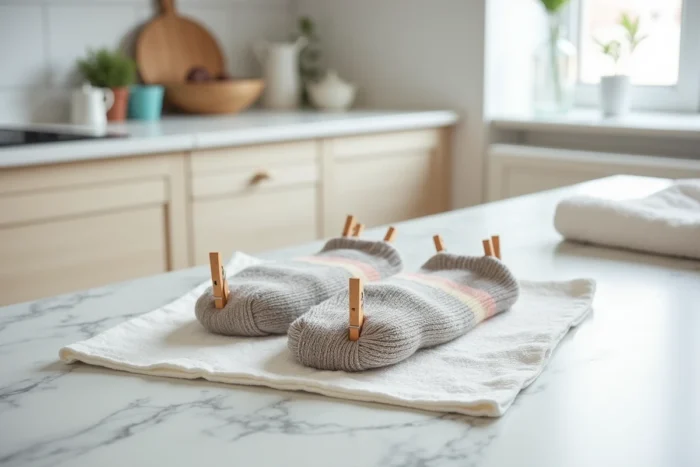
Drying under tension is the decisive phase. Without support, the sock returns to its shape as it dries, rendering the operation useless. Lay it flat on a towel or slide it over an object whose diameter corresponds to the desired width.
White vinegar or softener: what’s the difference?
White vinegar softens wool fibers by dissolving lime residues and slightly opening the scales of the fiber. The softener acts as a lubricant between the threads, making mechanical stretching easier.
Both work, but white vinegar is better suited for delicate wools because it does not leave a greasy film on the fiber. The softener, on the other hand, may reduce the sock’s absorption capacity over the long term.
Flat drying under tension: the method that articles forget
Most advice on shrunk socks stops at soaking. However, drying is what determines whether the expansion holds or not.
A damp wool sock is malleable. As it dries, the fibers fix in the position they occupy. If you leave the sock crumpled on a drying rack, it dries compressed, and the soaking effort is wasted.
Keeping the sock stretched throughout the drying process is what makes the difference between a temporary result and one that lasts through several wears. Use a glass bottle, a slightly inflated balloon, or simply your hand slipped inside to give the desired shape before laying the sock flat.
How long does the expansion last?
On a wool sock, the effect of soaking followed by drying under tension remains noticeable for a few wears. After a machine wash, the fiber tends to partially return to its original size.
Repeating the operation after each wash prolongs the result, but no home method produces a permanent expansion. It is regular maintenance, not a one-time solution.
When to stop insisting: the real limits of home expansion
Not all socks can be expanded. Forcing beyond what the fiber can tolerate damages the knit, creates transparent areas at the toes or heel, and ultimately renders the sock unusable.
- If the sock is predominantly synthetic (polyester, nylon), soaking will not yield measurable gains
- If the elastic of the ribbing leaves deep marks on the skin, the problem lies with the elastic band, not the knit, and no soaking will change an elastic
- If after two attempts at soaking and drying under tension the sock remains uncomfortable, the size simply does not fit your foot or calf morphology
A poor size choice cannot be corrected by soaking. Socks are knitted with calibrated tension. Gaining half a centimeter in width is realistic on wool. Expecting to go from a size 39-42 to a comfort of 43-46 is not.
The most useful reflex remains to check the composition and size guide before purchase. Brands that indicate foot width in addition to shoe size help avoid this problem at the source, especially for wide feet or strong calves.