
The message “injection to be checked” on a Clio 5 does not always indicate an injector problem. On the TCe 90 and 1.5 Blue dCi engines, the engine control unit raises this alert for anomalies affecting both the pollution control circuit and the electronic management. Identifying the actual source of the fault requires distinguishing mechanical failures from software or sensor malfunctions, two categories with very different costs and consequences.
Sensor, injector, or AdBlue circuit: what the Clio 5’s ECU really monitors
On the Clio 5, recent feedback paints a more nuanced picture than just a simple list of usual causes. Garages have reported since 2024 recent TCe 90 models, sometimes with only a few tens of thousands of kilometers on the clock, displaying the message “injection to be checked” accompanied by an unstable idle without a clear fault code on the diagnostic tool.
This observation points towards electronic management issues (ECU software, wiring, sensor) rather than a mechanical failure of an injector. On the Blue dCi diesel versions, the differential pressure sensor of the DPF and the AdBlue circuit are among the elements that most frequently trigger this alert, even when the mechanical injection system is functioning normally.
To understand in detail what “injection to be checked” means on Clio 5, one must reason beyond the simple fuel circuit and consider the entire pollution control chain.
Mechanical failure or electronic fault on Clio 5: comparative table
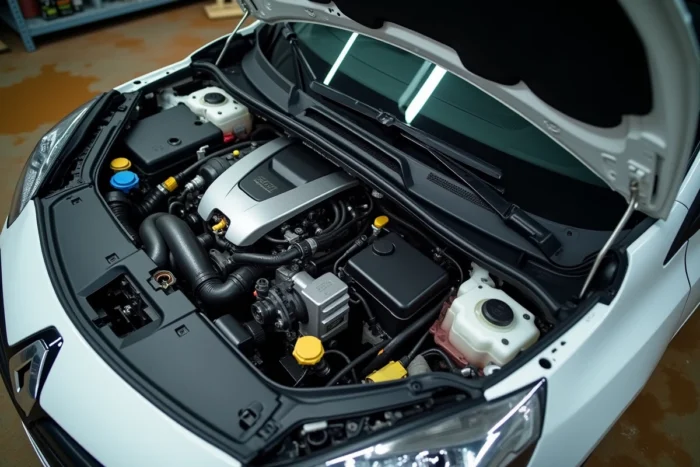
The diagnosis largely depends on the nature of the fault. The table below contrasts the two most frequent families of causes on the Clio 5, along with their symptoms and implications.
| Criterion | Mechanical fault (injection / supply) | Electronic fault (sensor / software) |
|---|---|---|
| Involved components | Injectors, fuel pump, fuel filter | DPF pressure sensor, lambda probe, AdBlue circuit, ECU |
| Typical symptoms | Marked power loss, jerking during acceleration, excessive fuel consumption | Unstable idle, intermittent message, no significant power loss |
| OBD tool reading | Explicit fault code (e.g., injector circuit, rail pressure) | Sometimes no clear fault code, or generic pollution code |
| Immediate severity | High: risk of engine damage if ignored | Moderate: degraded operation but no immediate mechanical risk |
| Resolution | Replacement or cleaning of the faulty part | Software update, sensor replacement, wiring check |
The gap between these two categories explains why the same message on the dashboard can lead to a bill of a few dozen euros (sensor) or to a much heavier intervention (replacement of injectors or high-pressure pump).
OBD diagnosis on Clio 5: why the tool is not always sufficient
The logical reflex when faced with the message “injection to be checked” is to connect an OBD2 diagnostic tool to read the fault codes. On the Clio 5, this approach encounters a documented difficulty: some electronic faults do not generate an explicit code. The ECU detects an anomaly, lights up the alert, but the code returned remains generic or absent.
Three elements deserve particular attention during diagnosis:
- The DPF differential pressure sensor, which can transmit inconsistent values without triggering a dedicated code. A plausibility test of real-time values can verify this.
- The AdBlue circuit on diesel versions, where a fault in level, liquid quality, or temperature probe causes the message without a direct link to the fuel injection system.
- The wiring of the injectors, where a micro-connection fault can cause an intermittent unstable idle, particularly difficult to reproduce in the workshop.
A mechanic who relies solely on fault codes risks unnecessarily replacing parts. Real-time data diagnosis (rail pressure, injection time, sensor values) remains the most reliable method for isolating the source of the problem on this generation of Clio.
Driving with the “injection to be checked” message: the concrete limits

The response directly depends on the type of symptom associated with the message. Without power loss or jerking, the vehicle operates in normal or slightly degraded mode. It remains possible to reach a garage under cautious driving conditions.
However, if the message is accompanied by a significant power loss or a switch to degraded mode (engine speed limited, inability to exceed a certain speed), continuing to drive exposes you to two risks:
- Accelerated degradation of the catalyst or particulate filter, linked to incomplete combustion that sends unburned fuel into the exhaust line.
- Potential damage to the turbocharger on TCe versions if the air-fuel mixture is persistently unbalanced.
- A blockage of the AdBlue system on diesels, which can prevent any restart of the vehicle after a certain number of ignition cycles if the fault is not corrected.
The intermittent message (which appears and then disappears) does not mean that the problem is resolved. The ECU may temporarily clear the alert if the values return to the acceptable range, but the underlying fault persists in the ECU’s memory and will reappear.
Evolution of pollution control systems and enhanced monitoring on recent Clio models
Discussions around the Euro 7 standard suggest a strengthening of real-time monitoring of pollution control systems. Future vehicles will have additional sensors and stricter monitoring software, with an “Environmental Vehicle Passport” intended to track compliance status throughout the vehicle’s life.
This trend partly explains why current Clio 5 models are already equipped with multiple sensors on the pollution control chain that trigger alerts for sometimes minimal deviations. The ECU’s tolerance threshold tightens from generation to generation, multiplying the cases where the message “injection to be checked” appears for a sensor or software fault rather than for a real mechanical failure.
On the Clio 5, a message “injection to be checked” without a clear fault code on the diagnostic tool points towards a sensor or electronic management issue, not necessarily towards an expensive injector replacement. Real-time diagnosis of engine values allows for precise identification of the fault’s origin before any intervention.