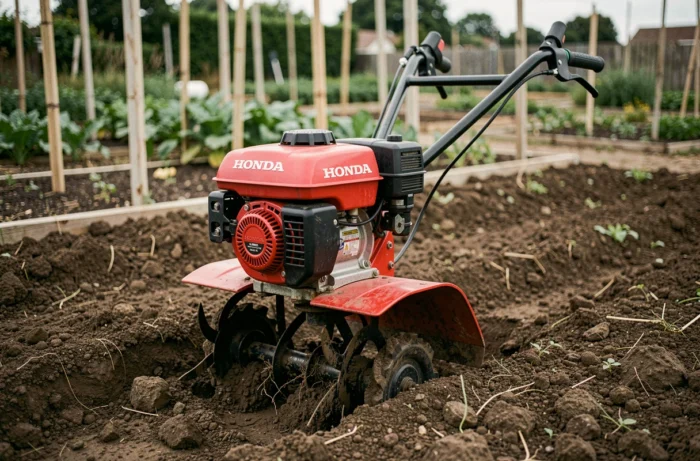
The Honda FG 320 equipped with the GP160 engine of 163 cm³ remains a benchmark in the segment of thermal tillers designed for medium to large areas. We analyzed it from the perspective of mechanics, transmission, and routine maintenance to determine if its reputation for reliability withstands serious technical scrutiny.
Chain drive and belt clutch of the FG 320: an underestimated mechanical choice
The transmission of the Honda FG 320 relies on a belt tension clutch coupled with a chain. This setup, less common than gear transmission on professional tillers, has a clear advantage: it absorbs jolts when attacking hard ground. The belt acts as a mechanical fuse that protects the transmission casing.
We observe that this type of transmission requires regular checking of the belt tension. A loose belt causes subtle slippage that degrades tilling performance without any obvious signal for the user. On the FG 320, access to the adjustment remains simple, but it should be considered at the beginning of the season.
The chain, on the other hand, requires periodic lubrication. A rarely mentioned point: in wet clay soil, dirt projections penetrate the casing if the seals are not inspected. We recommend a low-pressure jet cleaning after each session in sticky terrain. By cross-referencing the opinions on the Honda FG 320 tiller, we find this observation among several experienced users.
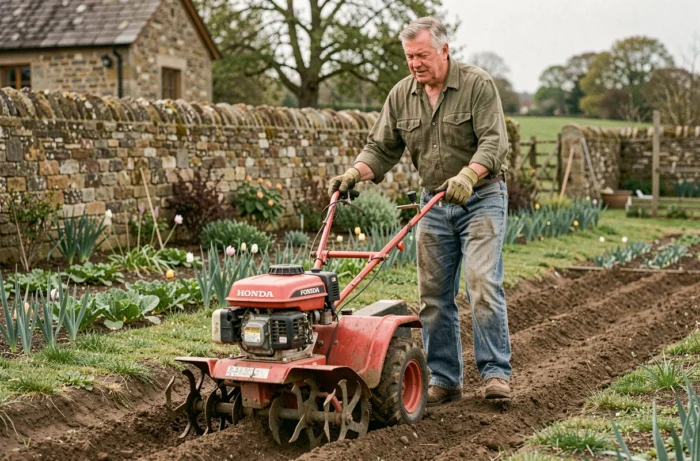
Honda GP160 Engine: Real Reliability and Maintenance Protocol
The GP160 develops 3.4 kW at 3,600 rpm with a torque of 10.3 Nm. It is a 4-stroke OHC engine with overhead valves, an architecture shared with other Honda equipment (generators, pumps). This platform sharing ensures a long-term supply of engine parts.
The reliability of the GP160 is not determined solely by the brand’s reputation. It directly depends on the maintenance protocol applied. The manufacturer’s recommendations emphasize a point often overlooked: the first oil change must occur quickly after commissioning. The metal particles from the break-in contaminate the oil much faster than in stabilized operation.
Oil and Filtration: What Determines Longevity
Using a 4-stroke oil that meets the specifications in the manual is non-negotiable. An oil that is too viscous in cold conditions complicates starting with the recoil starter and increases wear at startup. Conversely, an oil that is too fluid in the middle of summer offers insufficient protection under load.
- Check the oil level before each use, engine cold on a flat surface
- Seasonal oil change at a minimum, or after a number of hours defined by the manual
- Clean or replace the air filter after each session in dry and dusty soil
- Check the spark plug at the end of the season to detect a mixture that is too rich or fouling
The 2.4-liter tank provides a comfortable range for extended sessions. The recoil starter operates without notable difficulty when the fuel system is properly purged after winter storage.
Working Width and Tilling Depth: Sizing for Large Vegetable Gardens
800 mm working width and 325 mm depth place the FG 320 above the majority of consumer tillers. This sizing is suitable for vegetable gardens of several hundred square meters and recreational areas requiring regular soil work.
The 24 blades distributed on the tines attack the soil with sufficient aggressiveness to break a surface clay crust. In stony soil, repeated shocks stress the tine attachments. We recommend checking the tightening of the tine bolts every two or three uses.
Adjustable Handlebar and Maneuverability at 53 kg
The dry weight of 53 kg provides appreciable stability during work but makes maneuvers at the end of rows more physically demanding than with a lightweight tiller. The height-adjustable handlebar partially compensates for this by allowing the grip to be adapted to the operator’s morphology.
The presence of a reverse gear on this transmission distinguishes the FG 320 from entry-level models. In practice, the reverse gear avoids lifting the machine at the end of the row, which significantly reduces fatigue on large plots.
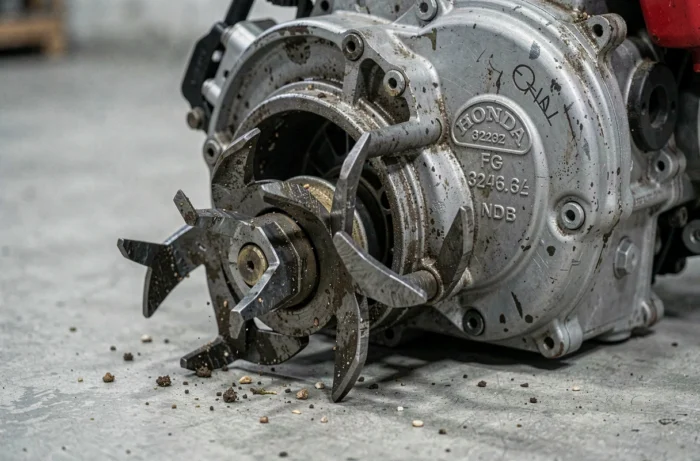
Availability of Honda FG 320 Spare Parts in France
One point that product sheets overlook: the longevity of thermal equipment depends as much on the availability of parts as on the quality of the engine. For the FG 320, GP160 engine parts (carburetor, rings, head gaskets) remain accessible through the Honda France dealer network.
Consumables specific to the tiller (tines, transmission belt, clutch cable) should be verified with the retailer before purchase. We have found that some online retailers offer compatible references, but exact compliance with Honda specifications is not always guaranteed.
- Tines and fixing bolts: wear parts to be anticipated from the first intensive season
- Transmission belt: lifespan varies depending on frequency of use and type of soil
- Air filter and spark plug: standard consumables, available outside the Honda network
A structured after-sales network remains the best indicator of long-term reliability. The ability to obtain a part in a few days rather than several weeks makes the difference between a temporary halt and a machine immobilized in the middle of the season.
The Honda FG 320 lives up to its mechanical promises as long as rigorous maintenance is respected and perceived robustness is not confused with invulnerability. The torque of the GP160 and the working width make it a powerful tool for substantial areas, but it is the regular monitoring of the transmission and engine that will determine its actual longevity over ten or fifteen seasons.