
On a campus, solidarity often starts with a simple gesture: lending notes to an absent student, sharing a meal when the end of the month comes too quickly, or pointing out an unknown assistance. These micro-actions, repeated on a large scale, form a safety net that neither scholarships nor public systems fully cover.
In France, student solidarity initiatives have multiplied in recent years, driven by associations, informal collectives, and university structures.
Solidarity grocery stores on campuses: a model spreading in France
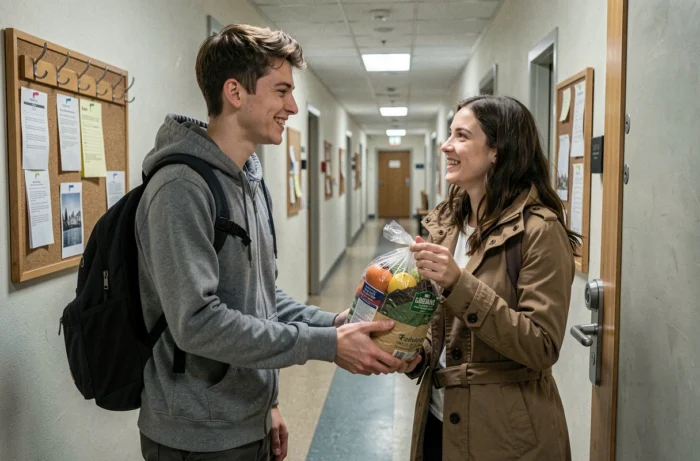
Food assistance remains the primary need expressed by students in difficulty. Campus solidarity grocery stores address this urgency with a concrete operation: essential products sold well below market prices, often around one-tenth of the standard rate.
In Marseille, a student solidarity grocery store opened in December 2025, aiming to serve as a replicable model in other university areas. The principle relies on partnerships with food banks and local businesses that provide unsold goods. The volunteers are students themselves, creating a direct support loop among peers.
Comparable structures have been operating for several years in other cities. Practical information on support networks, distributions, and available assistance can be found on solidariteetudiante.fr, which lists initiatives by city and type of need.
The 1 euro meal for students was expanded in 2026, now reaching a broader audience than just scholarship recipients. This system, combined with solidarity grocery stores, significantly reduces the burden of food costs in the monthly budget.

Collecting everyday items: solidarity through the circular economy
Buying a set of dishes, sheets, or a sweater when moving into a university residence represents a cost that many underestimate. Targeted collections allow these items to be redistributed for free to students in need.
In the Territoire de Belfort, a collection organized in September 2026 proposed a simple model: collecting everyday items rather than monetary donations. Sheets, kitchen utensils, warm clothing, small furniture. Donors are families whose children have completed their studies or individuals who are moving.
This type of local initiative works well because it requires no heavy structure. A space lent by the town hall or university, a few volunteers to sort and distribute, communication via campus social media. Feedback varies on the scale of donations depending on the regions, but the principle adapts to all sizes of university towns.
What makes a successful collection
- A calendar aligned with the start of the academic year (late August – early October), when needs are most acute for first-time residents
- Drop-off points accessible without a car, ideally on campus or in the city center, to avoid excluding students without transportation
- Pre-sorting by volunteers to ensure that redistributed items are clean and functional, avoiding the “junk” effect that discourages beneficiaries
Student support associations: beyond food distribution
Cop1, present in 23 cities in France, illustrates the broadening scope of student associations. Beyond food baskets, student support now covers access to rights, culture, and employment. This diversification responds to a field observation: student precariousness is not limited to an empty fridge.
Access to rights constitutes a frequent blind spot. Many students are unaware that they can benefit from housing assistance, social rates on transportation, or additional scholarships offered by their region. Associations play a guiding role that university services, often overwhelmed, struggle to fulfill alone.
Peer training and solidarity tutoring
Tutoring between students from different years constitutes a form of concrete academic solidarity. A third-year undergraduate helping a first-year student understand how the university works (registration for exams, access to libraries, choice of options) reduces the dropout rate in the first year.
Peer training works better than institutional programs on certain practical subjects: budget management, housing search, internship interview preparation. The proximity in age and experience creates a trust that the administrative framework does not always generate.
Student housing assistance and recent developments
Housing takes up the largest share of the student budget. Assistance exists, but access has become more complex for certain profiles. Since July 1, 2026, non-EU students face stricter conditions for housing assistance: some long-stay visa holders must now prove they have a scholarship based on social criteria to be eligible.
This development makes informal solidarity networks even more valuable. Groups of students organize systems of solidarity housing, where a student with accommodation temporarily hosts a peer awaiting a solution. Other collectives negotiate group rates with private residences.
The solidarity fund and development of student initiatives (FSDIE), linked to the student and campus life contribution (CVEC), allows university associations to fund these projects. Every student enrolled in higher education pays the CVEC, and part of this sum goes directly to social and solidarity life initiatives on campus.
Creating a solidarity initiative on your campus
Starting a project does not necessarily require creating an association under the 1901 law. An informal collective can organize a distribution, a repair workshop, or a tutoring group with minimal resources. The FSDIE funds projects led by students, provided a file is submitted to the institution.
- Identify a specific and localized need (food, supplies, administrative support) rather than aiming for a too broad objective
- Partner with an existing structure (BDE, student house, student life service) to benefit from a space and visibility without starting from scratch
- Document the actions taken to facilitate the handover to subsequent cohorts, as continuity remains the main challenge for student projects
Student solidarity in France relies on a network of modest but concrete actions. Grocery stores, collections, tutoring, housing assistance: each initiative addresses an aspect of precariousness that national systems do not fully cover. The most effective solutions are often the simplest, provided they are passed down from year to year.