When you remove an enameled piece from a kiln at over 900 °C to plunge it into sawdust, the result depends not just on the action. Raku ceramic glazing relies on a series of technical choices that determine the final appearance long before the smoking process. Clay, glaze, layer thickness, temperature: each parameter interacts with the others, and an error in one compromises the whole.
Thermal shock and chamotte clay: why the support conditions the glaze
Have you ever seen a piece crack when coming out of the kiln? In Raku, thermal shock is intentional. The piece goes from a very high temperature to open air, then often into a bin of sawdust or cold water. This mechanical stress requires a specific type of clay.
Chamotte clay absorbs the stresses of thermal shock thanks to the crushed fired clay grains it contains. These particles create a porous microstructure that withstands rapid expansion and contraction. A smooth clay, without chamotte, almost systematically breaks.
This choice of support has a direct impact on glazing. The porosity of the chamotte modifies the absorption of the liquid glaze. A highly chamotted clay absorbs the glaze water faster, resulting in a thicker layer in a single dip. With fine clay, it sometimes takes two or three layers to achieve the same thickness, increasing the risk of drips during firing.
To find information about Les Embellies Déco regarding these specific techniques, the link between chamotte grain size and glaze behavior is also discussed.
Low temperature Raku glazes: composition and usage limits
Raku glazes generally fire around 1,000 °C, classifying them as low-temperature glazes. Their base often contains frit (a pre-melted crushed glass), metallic oxides for color, and sometimes feldspar or kaolin to adjust viscosity.
The role of oxides in metallic effects
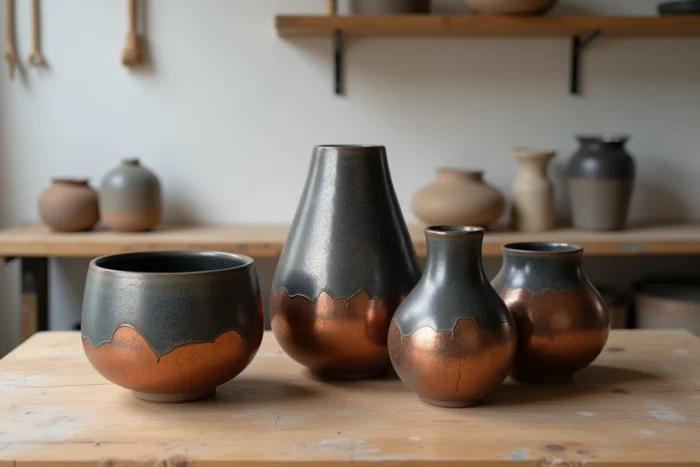
The coppery, silvery, or golden reflections that give Raku its reputation come from a redox reaction during smoking. When the glazed piece is plunged into the sawdust, the burning carbon deprives the glaze of oxygen. The metallic oxides (copper, iron, cobalt) then change their chemical state, altering their color.
Copper oxide illustrates this process well. In an oxidizing atmosphere, it produces greens. In reduction, it turns to copper red or pink. The result depends on the duration of smoking, the amount of sawdust, and the cooling rate.
Thickness of the glaze layer
Applying the glaze too thinly prevents the characteristic cracks from forming properly. If too thick, the glaze runs and sticks the piece to the firing support. The right thickness falls within a narrow range, which the ceramist learns to recognize by touch after dipping: the surface should appear slightly powdery without leaving marks on the finger.
- Dipping: the most common method in Raku, it gives a uniform layer if the piece is immersed and removed in a smooth motion, within two to three seconds.
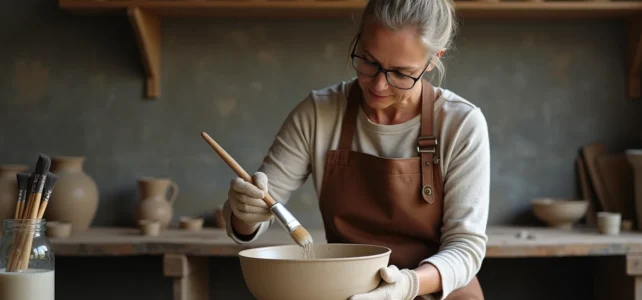
- Brush application: useful for detailed areas or localized effects, but it often leaves visible brush marks after firing.
- Spraying or pouring: practical for large pieces or sculptures, this technique requires speed to avoid excess thickness.
Safety in Raku workshops: fumes, burns, and ventilation
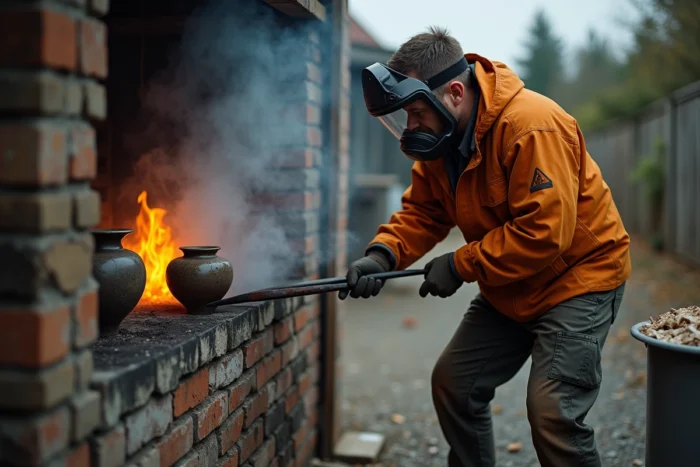
Raku firing is generally done outdoors, and for good reason. The smoking in sawdust produces dense fumes laden with fine particles and compounds from the combustion of organic materials. Working in a closed space without air extraction exposes one to serious respiratory irritations.
The long tongs used to remove pieces from the kiln should be at least arm-length. Wearing heat-resistant gloves, protective goggles, and a leather or fire-retardant fabric apron is part of the standard protocol. A piece at over 900 °C can project shards of glaze if it undergoes too rapid cooling.
A rarely mentioned point: the water in the cooling bin must be changed regularly. It accumulates residues of metallic oxides over the firings. Do not empty it into a stormwater system without checking local regulations on discharges.
Food contact of Raku pieces: an underestimated regulatory issue
Many ceramists sell Raku bowls or cups without considering their food compliance. The cracks that give this technique its charm are precisely what poses a problem: they create micro-passages where residues of metallic oxides (lead, cadmium, chromium) can migrate to food or beverages.
In France and the European Union, compliance relies on migration tests conducted on the finished piece, not just on the technical data sheet of the glaze. The “lead-free” mention from the supplier does not absolve the artisan of their legal responsibility. Only a test report on the glaze-clay-firing combination proves compliance.
- The test focuses on the migration of heavy metals (lead, cadmium, hexavalent chromium) in an acidic food simulant.
- The manufacturer or artisan must archive test reports for each glaze-clay-firing cycle combination they market.
- The European directive 2024/2853, applicable to products placed on the market from December 9, 2026, removes the threshold for damages, which increases the liability of ceramic artisans.
For purely decorative pieces, these constraints do not apply. Clearly stating “decorative object, not intended for food contact” on the label remains the simplest solution when one cannot afford compliance testing.
Raku produces unique pieces by nature, as each smoking gives a different result. This uniqueness has a technical downside: reproducing the exact conditions of a migration test on a series of handmade pieces is difficult. That is why most Raku ceramists direct their production towards decorative objects or sculpture rather than utilitarian tableware.