Redesigning or rethinking your bathroom often means choosing tiles, wall colors, and a vanity unit. These three decisions are enough to transform the space. But this year, choices are becoming more complicated: new regulatory constraints on plumbing fixtures, a return of materials thought to be outdated, and color choices that break away from the dominant all-white trend. Here are the concrete points to consider for a modern bathroom in 2026.
Plumbing Fixtures and Water-Contact Materials: What European Regulations Change
Have you noticed that some entry-level faucets are disappearing from catalogs? It’s not a coincidence. The European directive on drinking water (2020/2184) requires, starting December 31, 2026, positive lists of authorized substances for any material in contact with drinking water: faucets, fittings, shower hoses, built-in pipes.
Each product must have a European conformity assessment and meet enhanced hygiene requirements, particularly regarding lead. The limit is set at 5 µg/L at the faucet for new materials, effectively eliminating several cheap alloys still common.
For a modern bathroom project, this means two things. First, check the DWD certification of each plumbing fixture before purchase. Second, anticipate a likely tightening of the entry-level offering by 2027. Manufacturers who already provide detailed technical sheets on the composition of their alloys are the ones who will remain in the catalog.
Specifically, if you’re renovating this year, prioritize brands that clearly display compliance with this directive. It’s a less visible criterion than a gold finish, but much more sustainable. A comprehensive overview is offered among bathroom trends on Batiwiz, which also details the relevant equipment.
Trendy Bathroom Colors: Leaving White Without Making Mistakes
White remains a safe choice. But the striking trend of 2026 is the adoption of earthy and enveloping tones on walls and furniture. We’re talking about clay tones, rosy beige, sage green, and warm brown.
Why this shift? The bathroom aligns with the rest of the home: we’re looking for a cocooning atmosphere, inspired by spas and Japanese interiors. The clinical all-white gives way to softer palettes.
How to Integrate Color Without Risking Fatigue
The most reliable rule: limit strong color to a single vertical plane. An accent wall in tinted tiles or plaster, with the rest in neutral tones. This avoids the enclosing effect in a space that is often compact.
- Sage green works particularly well with light wood and matte black plumbing fixtures.
- Terracotta or ochre tones pair well with reconstituted stone sinks and brushed brass.
- Anthracite gray, used only on the floor, visually enlarges the space when the walls remain light.
A common mistake is choosing color on a screen. A physical sample, placed in the bathroom under actual lighting (often artificial), radically changes the perception of the tone.
Large Format Tiles and Natural Materials: The Duo That Structures the Space
Large format tiles continue to gain ground. Slabs of 120 x 60 cm, or even 120 x 120 cm, reduce the number of visible joints. Fewer joints mean a surface that is easier to maintain and a feeling of expanded space even in a small bathroom.
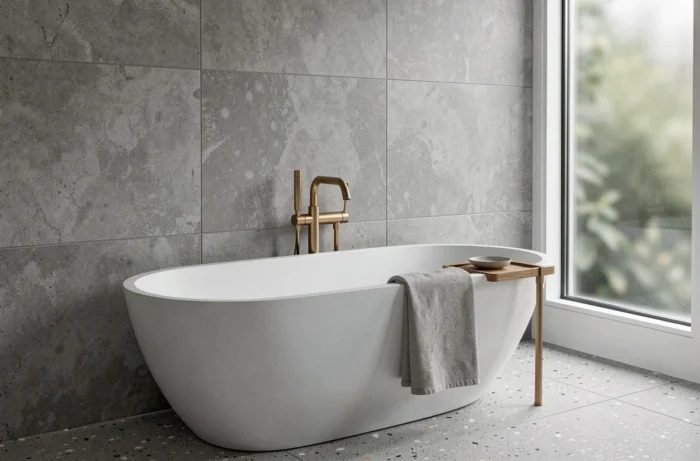
Natural stone effect tiles (travertine, terrazzo) dominate showrooms this year. They bring the texture and warmth of raw material without the maintenance constraints of real stone. Wood-effect porcelain stoneware remains highly sought after, especially for floors.
Combining Tiles and Real Wood
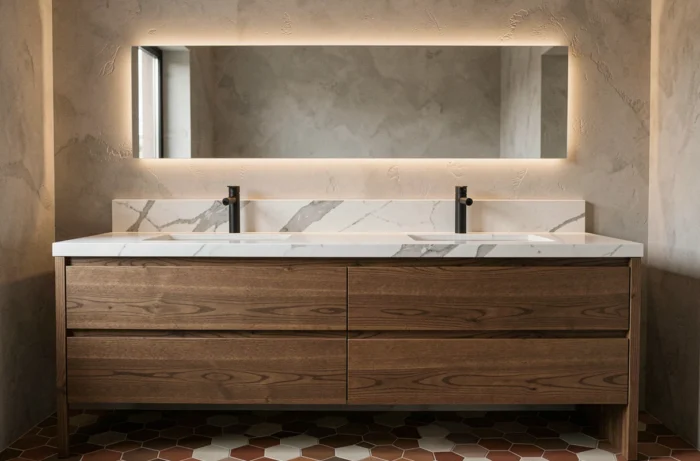
Wood is not prohibited in bathrooms. Species like teak or treated oak resist humidity if ventilation is adequate. A solid wood sink top placed on a wall-mounted tiled unit creates a material contrast that adds character to the space.
The trick is to reserve wood for areas that do not receive direct splashes: worktops, high shelves, mirror frames. The tiles cover the rest.
Italian Shower and Wall-Mounted Vanity: Equipment That Redefines the Layout
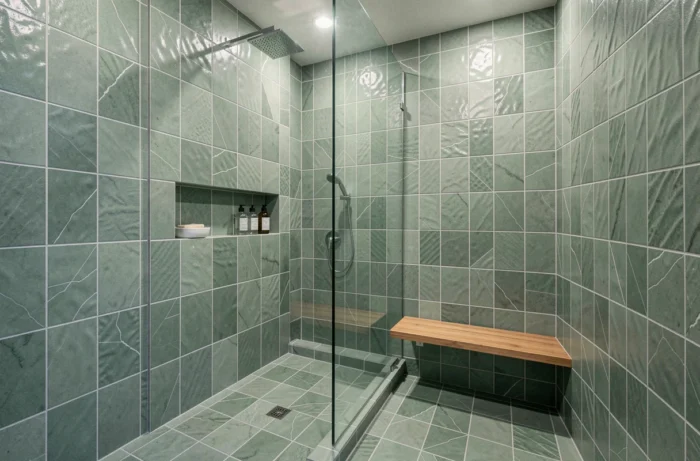
The Italian shower remains the most popular layout. Its main advantage is not aesthetic: it’s the removal of the raised shower tray that frees up the floor plan and simplifies accessibility.
Recent models incorporate nearly invisible linear shower drains and ultra-clear glass walls without visible profiles. The result is a shower area that blends seamlessly into the surrounding tiles.
The wall-mounted vanity complements this logic of visual lightness. Fixed to the wall, it frees up the floor and facilitates cleaning while creating a floating line. Models with integrated double sinks, without protruding edges, are gaining traction in medium-sized bathrooms.
- A wall-mounted unit of 80 to 120 cm suits most configurations.
- Wood veneer or matte lacquer finishes are gradually replacing glossy melamine.
- Push-to-open drawers (without handles) enhance the overall streamlined look.
Integrated Lighting: A Detail That Changes Perception
A LED strip under the sink unit or behind the mirror completely alters the ambiance. It’s a low-cost addition that eliminates shadowy areas and adds unexpected depth to a space that is often windowless.
Opt for a color temperature around 3,000 K (warm white) for the general ambiance, and a cooler light (4,000 K) above the mirror for accurate color rendering.
The bathroom of 2026 is not just about decorative style. Between new standards on materials, the shift towards natural palettes, and the upgrading of standard equipment, every technical choice has a direct impact on the comfort and durability of the space. Tiles, plumbing fixtures, and lighting deserve as much attention as the wall colors.