A shiny sink does not guarantee that the air in your kitchen is healthy. Recent studies on indoor air quality show that industrial cleaning products release volatile organic compounds to the point that the indoor air of a home can be several times more polluted than outdoor air. Taking care of your home on a daily basis is therefore as much about method as it is about product choice.
Indoor air quality and household products: the invisible trap
Have you ever noticed that stubborn “clean” smell after a big cleaning session? This scent signals the presence of suspended chemical molecules. Air fresheners, scented candles, multi-surface cleaners with pine or industrial lavender scents: all emit fine particles and volatile compounds into living spaces.
Experts in air monitoring in France remind us of a simple principle: cleanliness has no smell. A floor well washed with hot water and a bit of black soap emits nothing. A floor cleaned with a scented product continues to emit pollutants for several hours.
For regular cleaning, three products are enough to cover most tasks: white vinegar for descaling, black soap for degreasing, and baking soda for scrubbing. Finding home information on Kali News allows for a deeper exploration of topics related to home maintenance.
Another underestimated reflex: ventilate for at least ten minutes every day, even in winter. Opening windows after cooking, vacuuming, or using a cleaning product expels a large part of the accumulated pollutants. A well-functioning mechanical ventilation system complements this action but does not replace it.
Kitchen maintenance: actions that prevent accumulation
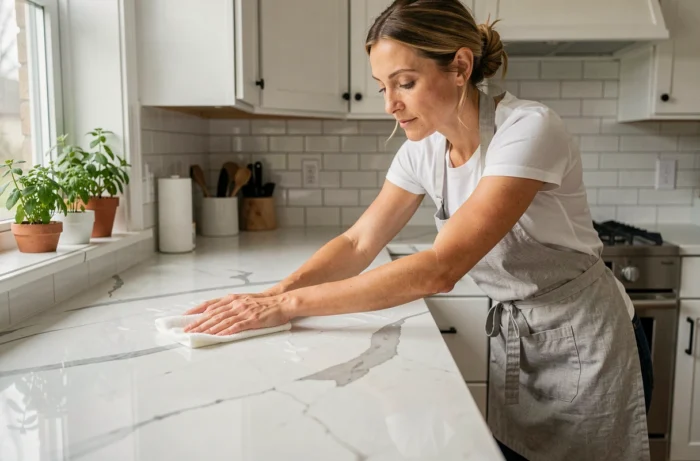
The kitchen concentrates grease, humidity, and food residues. It is the room where deferred cleaning costs the most time. One principle works better than all schedules: clean each surface immediately after use.
Specifically, wiping the still-warm cooking surface takes thirty seconds. Waiting until the next day turns the same task into five minutes of scrubbing. The same reasoning applies to dishes: rinsing them before they dry prevents prolonged soaking and limits bacterial proliferation in the sink.
The often-forgotten black spots
Some areas of the kitchen escape regular cleaning while quickly accumulating dirt and bacteria:
- The seals of the sink and countertop, where mold and food residues get embedded. A weekly wipe with white vinegar is enough to keep them clean.
- The filter of the range hood, which loses efficiency when clogged. Soaking it once a month in soapy hot water restores its suction power.
- The handles of furniture and appliances, which are among the most touched surfaces in the house. A daily wipe with a sponge and soap limits the transmission of germs.
Adopting these actions does not require extra time. It is about shifting the effort to the right moment rather than letting dirt settle in.
Organizing living spaces: fewer objects, less maintenance
An overloaded piece of furniture attracts dust and makes dusting laborious. Before looking for storage tips, the first question to ask is about the volume of objects themselves.
Every object placed on an open surface multiplies cleaning time. A shelf with five books can be dusted in a few seconds. The same shelf with thirty knick-knacks requires moving everything.
Sorting to facilitate cleaning
Sorting is not just about clothes. Kitchen drawers, bathroom cabinets, and entryway closets accumulate unused items that hinder access to everyday objects.
A simple method: turn over or mark all items in a given closet. After three months, everything that hasn’t been touched deserves to be given away, sold, or thrown away. This regular decluttering reduces the number of surfaces to clean and makes daily organization easier.
For the storage furniture itself, prefer closed models (doors, drawers) rather than open shelves to protect items from dust. The time saved on weekly cleaning is significant.
Laundry and bathroom maintenance: frequency and method
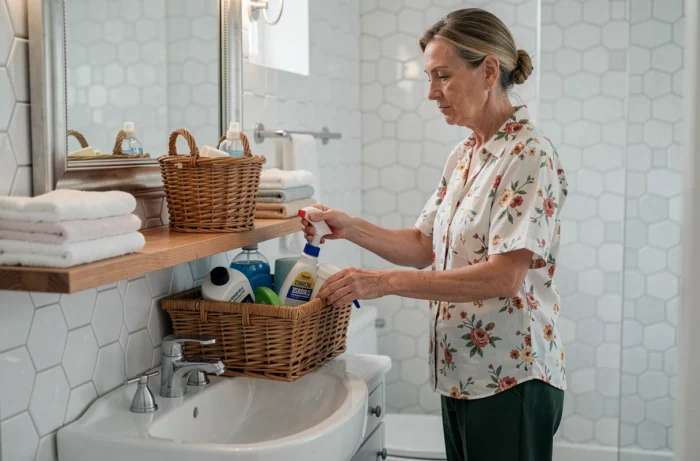
The bathroom shares a humidity problem with the kitchen. Stagnant humidity is the primary cause of mold in a home. After each shower, using a squeegee on the glass walls and leaving the door open for ventilation significantly reduces limescale deposits and black marks.
For laundry, a common mistake is running half-full loads. Grouping laundry helps reduce the number of washes without letting dirty laundry accumulate. Two to three loads per week cover the needs of an average-sized household.
Laundry products and labeling
European regulations are gradually tightening labeling requirements for household products, including laundry detergents. Hazard symbols and allergen lists must be clearly displayed on the packaging. Reading these labels before purchase helps avoid products containing irritating substances, especially for households with young children.
A product with a certified environmental label is preferable to a product with unverified “green” claims. Since 2025, European regulations have more strictly governed generic ecological claims on packaging, making official labels more reliable as a reference.
Ultimately, maintaining your home on a daily basis relies on a few principles: act at the right moment rather than postponing, reduce the number of objects and products, and ventilate regularly. The most effective actions are rarely the most spectacular, but they are the ones that last over time.