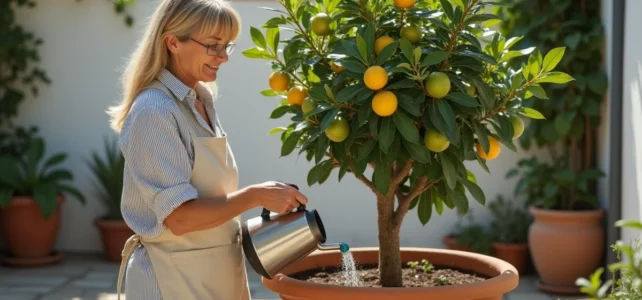
A potted lemon tree losing its leaves in the middle of summer, despite being watered regularly: the scenario is puzzling, yet it repeats itself every year on balconies and terraces. The question is not just when to water, but understanding what in the immediate environment of the pot causes stress that water alone cannot correct. This article compares the factors that truly affect the health of a potted lemon tree and measures their relative impact.
Thermal stress of the potted lemon tree: the underestimated factor
Most guides focus on the frequency of watering. Recent data shifts the focus: beyond about 32 °C in stagnant air, the lemon tree switches to survival mode. Leaves drop, mini lemons fall, growth stalls. This threshold is reached very quickly on a balcony sheltered from the wind, between a facade wall and a glass railing.
The pot itself exacerbates the phenomenon. Placed on a concrete or stone slab exposed to the sun, it accumulates heat from the bottom. The shallow roots literally cook, and no amount of watering compensates for a substrate temperature that rises well beyond what the plant can tolerate.
Mastering the watering and care of the potted lemon tree starts with managing the thermal environment before touching the watering hose.
| Stress Factor | Impact on the Lemon Tree | Priority Solution |
|---|---|---|
| Stagnant heat (air > 32 °C) | Leaf and fruit drop even with correct watering | Move the pot away from walls, elevate it, create air circulation |
| Burning slab under the pot | Root overheating, partial asphyxiation | Elevate the pot on wedges or a perforated support |
| Compact and dry substrate on the surface | Water runs off without penetrating, roots lacking | Thick organic mulch applied before the first heat wave |
| Repeated hard water | Iron absorption blockage, chlorosis (yellow leaves) | Use rainwater or let tap water sit |
| Overwatering in winter | Root rot, leaf drop | Drastically reduce frequency, check drainage |
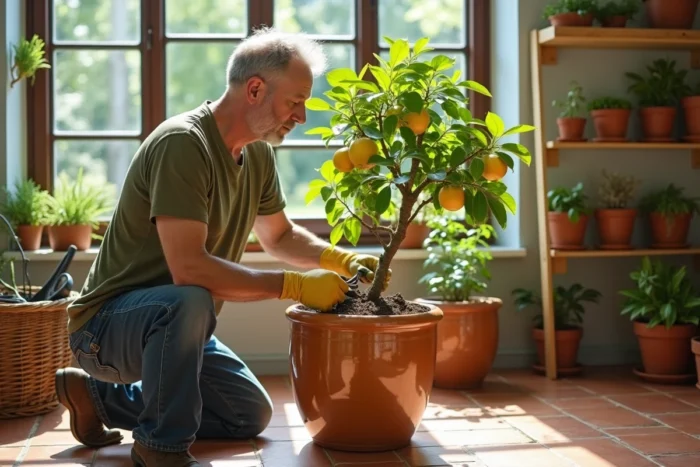
Water and substrate quality: what matters more than frequency
Watering a potted lemon tree three times a week or once a day doesn’t matter much if the water and substrate are problematic. Two parameters deserve special attention.
Hard water and chlorosis
Water that is too hard blocks iron absorption by the roots. The symptom is characteristic: leaves turn yellow between the veins, which remain green. This is not a lack of fertilizer; it is a pH problem at the root level. Rainwater remains the best option. If not available, letting tap water sit for a day in an open watering can partially reduces chlorine, but not hardness.
Substrate and drainage
A substrate that is too compact promotes root asphyxiation. After one or two years in a pot, the substrate settles, retains water on the surface, and remains dry at depth. The lemon tree then shows contradictory signs: soft leaves (lack of water at the roots) and moist substrate on the surface.
- Mix coarse sand or pumice with the citrus potting mix during repotting, at about one quarter of the total volume
- Check that the pot’s drainage hole is not blocked by a mass of roots or compacted substrate
- Install a layer of clay pebbles at the bottom of the pot, a few centimeters deep, to prevent the roots from sitting in stagnant water
Drainage conditions the survival of the lemon tree much more than the volume of water provided.
Mulching the potted lemon tree: the game-changing gesture in summer
Mulching remains little practiced on pots, even though it simultaneously solves several problems. A thick organic mulch applied before the heat peak limits evaporation, maintains a more stable substrate temperature, and reduces the need for watering.
Specifically, a layer of mulch (pine bark, flax flakes, cocoa shells) placed on the substrate creates a thermal barrier. However, mulch applied too late, when the substrate is already burning and dry, traps heat instead of regulating it. Timing is as important as the action itself.
This mulch is removed or lightened in autumn to allow the substrate to dry faster between waterings, preparing for the transition to the winter rest period.
Watering the lemon tree according to the seasons: adapting the rhythm
The potted lemon tree is not managed the same way in July as in January. Here are the key guidelines.
- In summer, water generously as soon as the top few centimeters of substrate are dry to the touch, preferably early in the morning or in the evening. A deep and spaced watering is better than light and frequent applications
- In spring and autumn, gradually reduce the frequency. The lemon tree prepares for flowering and needs a slightly moist substrate, never waterlogged
- In winter, the lemon tree enters a relative dormancy. Watering is reduced to a strict minimum, especially if the tree is brought into a cool room. Excess water at this time causes root rot
- During heatwaves, do not increase the watering frequency without first checking the mulch, the pot’s location, and air circulation
Fertilizers and feeding
A regular application of special citrus fertilizer between March and September supports fruiting. Fertilization is suspended in winter, when the tree slows its metabolism. An excess of fertilizer on a lemon tree stressed by heat or poorly drained worsens the damage instead of correcting it.
Wintering the potted lemon tree: mistakes that kill the tree
The lemon tree cannot withstand prolonged frost. As soon as nighttime temperatures regularly drop below 5 °C, it must be brought inside. An unheated veranda, a bright garage, or a cool room are suitable, provided the temperature remains stable and there is sufficient light.
A common mistake is placing the lemon tree in a living room heated above 20 °C. The dry air from central heating dries out the foliage within a few weeks. The tree loses its leaves, weakens, and struggles to recover in spring. The ideal wintering temperature is between 5 and 12 °C.
When spring returns, the transition outside should be gradual. Placing the lemon tree directly in full sun after several months indoors causes leaf burn. A few days in partial shade are enough to readjust the tree.
The potted lemon tree rewards those who observe before acting. A tree that is yellowing does not necessarily lack water, and a tree that drops its fruit in summer does not necessarily lack fertilizer. The substrate, drainage, pot location, and ambient heat weigh more than the watering schedule displayed in most guides.