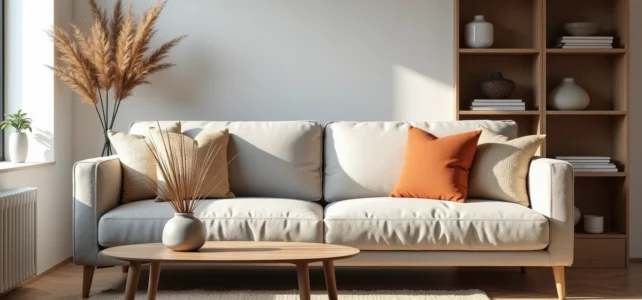
A wall that seems too low, a living room where you have to navigate around the sofa instead of moving freely, a dark kitchen despite a decent window: these situations are rarely resolved by simply adding a decorative object. Decorating and arranging a home with style starts with solving concrete problems of volume, light, and flow before choosing a cushion or a frame.
Color capping: the painting technique that replaces the accent wall
For a long time, one wall was painted in a bold color, while the rest remained white. The result visually splits the room in two and quickly becomes outdated. The trend now dominating interior decoration is based on color capping: a single shade extended from the wall to the ceiling, sometimes even onto the woodwork.
In practice, you choose a color, such as olive green or greige, and then apply it to all vertical and horizontal surfaces in a room. The variations remain subtle, with a half-tone lighter on the ceiling and a half-tone deeper on the woodwork. The enveloping effect visually enlarges small spaces because the eye no longer encounters a harsh contrast between white walls and ceiling.
Pure whites are giving way to warm neutrals like sandy beige or soft terracotta. These shades work particularly well in apartments, where natural light varies from room to room. They absorb less brightness than a cool gray while maintaining a sleek line. For those looking to access Niddou’s home page, room-by-room inspirations allow you to visualize these palettes in real situations.
Flow in the living room and kitchen: three common layout mistakes
Furniture often arrives before the circulation plan, and we end up squeezing a chair into whatever space is left. The result: we zigzag between the furniture daily. Before decorating anything, mentally trace the path from the entrance to each usage area (sofa, table, kitchen).

Here are the three most common blockages:
- The sofa pressed against the wall in a large living room, creating an unusable central void. Shifting it a few dozen centimeters toward the center structures the space and clears a passage behind.
- The kitchen island oversized for the room. If you can’t move freely on both sides with the cabinets open, the island hinders more than it helps.
- The absence of a buffer zone between the entrance and the living room. A low piece of furniture, a rug, or a change in flooring is enough to mark the transition without putting up a partition.
Every piece of furniture must justify the floor space it occupies. A sideboard that only serves as a display surface takes up a linear meter that could be freed for circulation or a more useful closed storage.
Natural materials and discreet home automation: the modern style that lasts
We are increasingly seeing interiors that mix raw wood, linen, stone, and technological elements, but with a non-negotiable rule: technology remains invisible. Built-in wiring, speakers integrated into the walls, lighting controlled without visible boxes. Modern design in home decoration relies on this tension between visible natural materials and hidden electronics.
Solid wood (oak, walnut, ash) remains the reference material for durable furniture. It is combined with textiles made from natural fibers, linen or boucle wool, to create a contrast of textures without overcrowding the space.
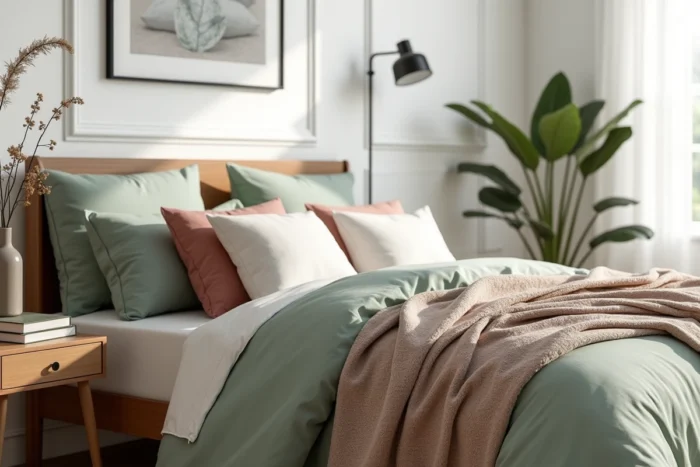
Plants play a structuring role, not just a decorative one. A large ficus in a dead corner of the living room absorbs echo and softens a space that is too mineral. Hanging plants above a kitchen countertop break the horizontal line of the upper cabinets.
Which furniture to prioritize for a cohesive interior
Cohesion does not come from imposing a single style throughout the house. It comes from a material common thread. Choose two or three dominant materials (for example, light oak, matte black metal, and ecru linen) and stick to them in all rooms. A material common thread avoids a catalog effect without standardizing the atmosphere.
Organic, rounded shapes take precedence over strictly geometric lines in furniture. Oval tables, chairs with curved armrests, irregular mirrors: these choices soften a room where the walls and openings already impose many right angles.
Bathroom renovation: the details that change the style
The bathroom often concentrates decoration errors because it is treated last, with the remaining budget. However, a simple detail can transform the room: replacing a standard shower screen with a black metal and ribbed glass workshop-style partition. The cost remains moderate, and the visual effect restructures the entire room.
The floor deserves as much attention as the walls. Subway tiles, laid staggered on the floor in gray or anthracite tones, add character without dating the space. Avoid the total white tile look, which turns the bathroom into a clinical space.
A colored vanity unit (brick red, forest green, midnight blue) is a better replacement for the default white or light wood unit. Reactions vary on this point depending on the size of the room, but in a medium-sized bathroom, a colored unit works as a focal point without overwhelming the space.
Decorating and arranging your home with style comes down to precise technical choices: a flat color extended to the ceiling, a piece of furniture moved a few centimeters, a natural material repeated from one room to another. It is these micro-decisions, made room by room, that produce an interior that is both personal and functional.