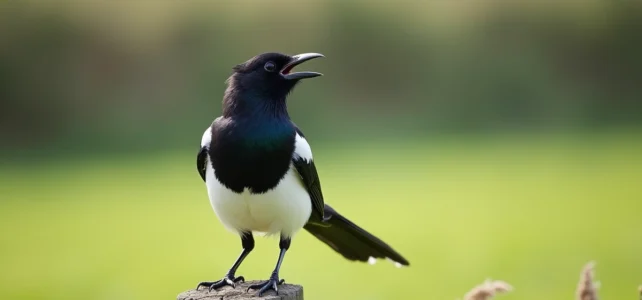
One often hears the magpie chattering above a vegetable garden, a terrace, or a roof, and immediately concludes that it is furious. However, the call of the Eurasian magpie (Pica pica) is much more than a sign of anger. It serves specific functions, adapted to situations that can be observed in any garden or housing development. Understanding these vocalizations allows for better coexistence with this often-misjudged bird.
Alarm call of the magpie: a sentinel that protects the group
When trimming a hedge and a magpie starts to scream repeatedly above us, we think of aggression. In most cases, the magpie emits an alarm call intended for other birds, not a cry of rage. This sound signal warns its peers, as well as other species (blackbirds, tits), that a potential danger is approaching the area.
This function as a community sentinel is well documented among corvids. The magpie does not scream because it hates us. It screams because it has spotted unusual movement (human, cat, raptor) and is fulfilling an alert role within the network of birds present in the area.
To understand how the angry magpie’s call works, one must distinguish at least three types of vocalizations that can be recognized in the field:
- The rapid, staccato chattering, emitted in short bursts: this is the classic alarm call in the face of a predator or an intrusion on its territory
- The descending call, deeper and prolonged: often associated with a situation of moderate stress or an exchange between individuals of the same pair
- The continuous low-volume chatter: a chirp that the magpie produces at rest, sometimes imitating surrounding sounds (other birds, mechanical noises)
Responses vary on this point, but most regular observers note that the staccato chattering remains the most frequent in peri-urban contexts, where sources of disturbance are numerous.
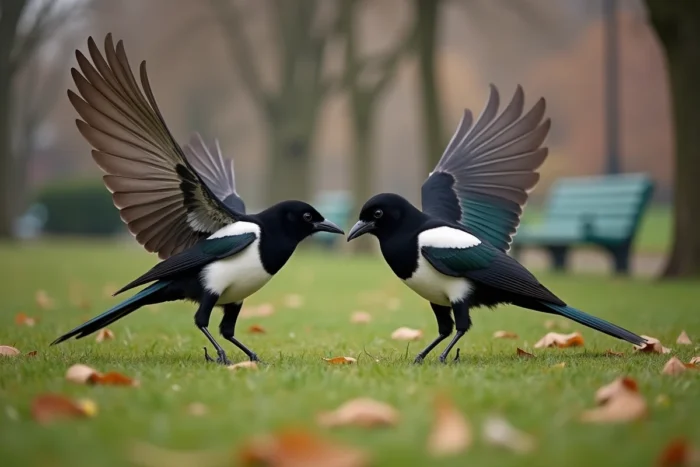
Eurasian magpie classified as ESOD: why calls intensify in inhabited areas
In France, the Eurasian magpie regularly appears among the species likely to cause damage (ESOD). This classification allows for regulation actions through trapping or shooting, carried out by hunters and land managers. Articles describing the magpie’s call almost always overlook this regulatory context, even though it directly modifies the bird’s vocal behavior.
Specifically, in areas where regulation is active (agricultural plots, around chicken coops, housing developments on the outskirts), magpies experience frequent disturbances. Approaching a human armed with a trap, vehicles passing on paths, the presence of hunting dogs. Each intrusion triggers an alarm call, which gives the impression that the magpie is constantly “angry.”
Thus, two things are confused: an aggressive bird and a bird on high alert due to human pressure on its habitat. In densely urban areas, where regulation is absent, magpies are generally quieter and allow for closer approaches.
Vocal mimicry of the magpie: the most common confusion
The Eurasian magpie is among the birds capable of reproducing external sounds. This vocal mimicry, less known than that of the Eurasian jay or the parrot, seriously complicates the interpretation of its calls.
Observations relayed by communities and naturalist pages report that magpies reproduce fragments of phone ringtones, car alarms, and even snippets of human voices. An unusual magpie call is not necessarily a signal of anger: it may be an imitation integrated into the individual’s vocal repertoire.
When one hears a strange sound coming from a magpie and searches for “angry magpie call,” one encounters explanations that do not take this mimicking ability into account. Before concluding aggressive behavior, one should observe the bird’s posture.
Raised tail, ruffled feathers, and a dive indicate a true territorial reaction. A perched bird emitting a strange sound is often simply “chattering.”
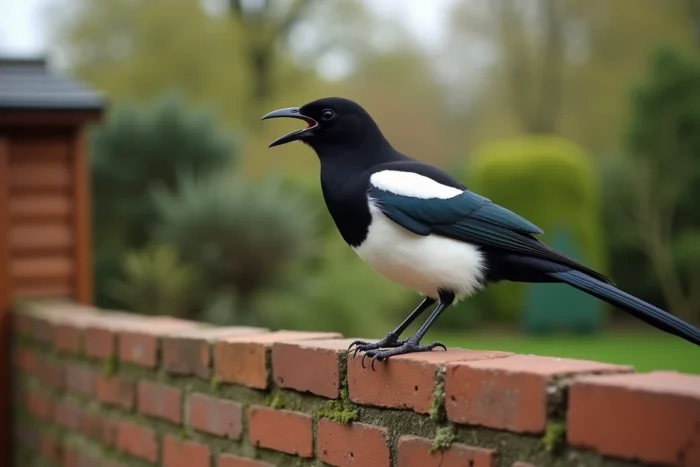
Common misconceptions about the angry magpie: what is myth
The magpie has carried a reputation as a thief and a bird of ill omen for centuries. These popular beliefs color the interpretation of its vocalizations.
The magpie screams because it is mean
No. The magpie screams to communicate. Alarm, nest defense, exchange with a partner, vocal learning of young. No vocalization of the magpie conveys meanness. It is a social corvid that uses a rich vocal repertoire to coordinate its group activities.
The magpie attacks humans for no reason
Flight charges occur almost exclusively during the nesting period when a human gets too close to the nest. This is a time-limited defensive behavior (a few weeks), not a gratuitous aggression. The risk can be reduced by avoiding parking under a spotted nest.
The louder a magpie screams, the more aggressive it is
The volume of the call depends more on the distance between the magpie and the perceived threat than on its level of “anger.” A magpie that chatters loudly is often simply close to the source of disturbance. Moving a few meters away usually reveals that the volume decreases and the bird calms down.
The next time a magpie chatters above your head, observe its posture and the context before concluding that it is angry. Raised tail and low flight towards you during nesting season: back off, it is a mother defending her young. Continuous chatter from a branch without particular movement: it is simply doing what magpies do, making noise.