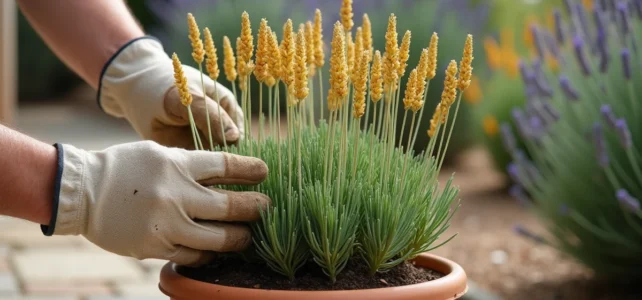
Your lavender is showing yellow foliage when it seemed to be in good shape just a few weeks ago. This yellowing almost always indicates an imbalance between the soil, water, and sunlight. Before treating blindly, it’s better to identify the precise cause to act in the right place.
Soil that is too wet: the main cause of lavender yellowing
Lavender (Lavandula angustifolia and its varieties) is a Mediterranean plant accustomed to dry, stony, and well-drained soils. When its roots are submerged in excess water, they lack oxygen and begin to rot. The foliage reacts by yellowing, sometimes in just a few days.
Have you noticed that yellowing often appears after a long period of spring rain? That’s exactly the mechanism. Clay or compact soil retains water like a sponge, and lavender does not tolerate it well.
If you are growing your lavender in a pot, check that water is not pooling in the saucer. A standard potting mix is often too rich and retains too much moisture for this plant. Mix it with coarse sand or gravel to improve drainage. In the ground, adding gravel at the bottom of the planting hole during installation can prevent many problems later on.
To understand what to do if the lavender is yellowing, you first need to examine the condition of the roots. Gently dig up the plant: black and soft roots indicate established rot. In this case, taking cuttings from the still-healthy stems is the best way to save the plant.
Watering lavender in pots and in the ground: common mistakes
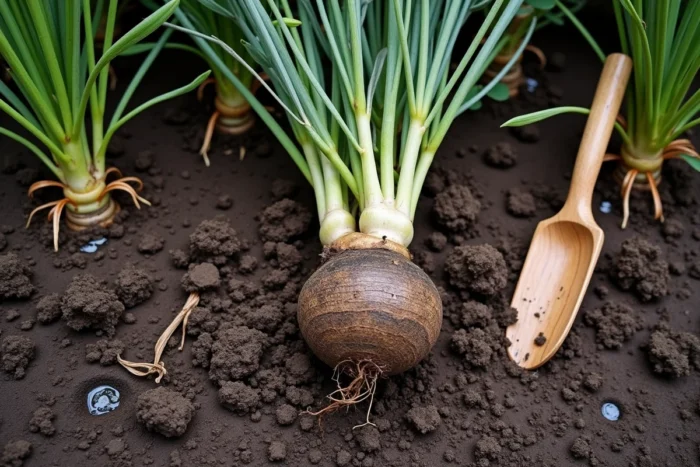
The reflex to water your lavender regularly like a geranium causes more damage than drought. Lavender planted for over a year in the ground typically needs no watering under normal conditions, except during prolonged heatwaves.
The situation is different for young plants. The first year after planting, lavender needs regular watering to develop its root system. Increasingly dry and windy springs, linked to climate change, quickly dry out the surface soil. A juvenile lavender that is not watered in spring will yellow and decline within weeks.
Another trap to be aware of: watering restrictions due to drought orders. Depending on your department, garden watering may be prohibited or limited to certain hours in summer. These constraints sometimes come at the time when young lavenders would need a water supply.
How to adjust watering according to the age of the plant
- Lavender planted for less than a year: water once or twice a week if the soil is dry on the surface, preferably in the morning to limit evaporation
- Lavender established for two years or more in the ground: leave it alone, unless the lower leaves start to dry out in mid-summer
- Lavender in pots: wait until the substrate is dry on the top two centimeters before watering, and always empty the saucer afterward
Fungal diseases and pests: when yellowing comes from elsewhere
Wet soil also promotes the appearance of fungi. Sooty mold, recognizable by its black deposits on the leaves, develops when ambient humidity remains high. Lavender rust forms small reddish spots on the foliage and progressively dries out the stems.
These fungal diseases are not the primary cause of yellowing but a consequence of the same problem: too much moisture. Correcting the drainage often suffices to halt their progression.
On the pest side, sharpshooters are the most formidable. These small insects feed on sap and transmit a phytoplasma that causes rapid decline of the plant. The leaves yellow, the stems dry out, and the plant dies within months. If several lavender plants yellow simultaneously and the roots appear healthy, sharpshooters are a serious lead.
Pruning lavender: the forgotten action that causes yellowing
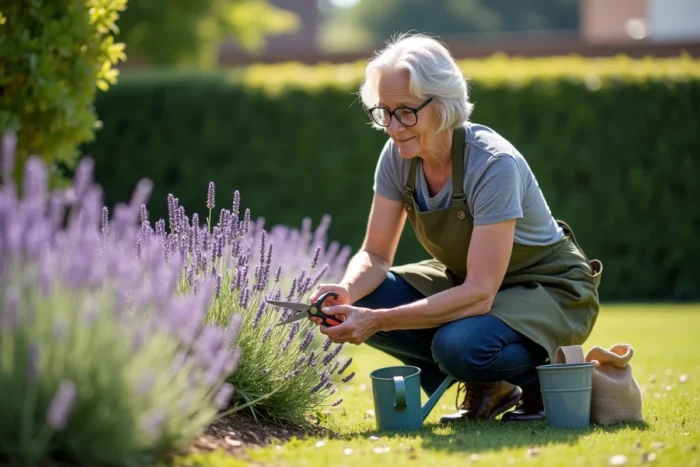
Do you prune your lavender every year? If the answer is no, the yellowing at the base of the plant may be explained by simple aging of the wood.
Lavender produces new green shoots each year on the wood from the previous year. Without annual pruning, the base becomes woody and the lower leaves yellow and then fall off. The plant then takes on a gangly shape, with bare wood topped by a few green tufts.
When and how to prune to avoid yellowing
Pruning is done just after flowering, usually between July and September depending on the regions. Shorten the flower stems and part of the green foliage, but never cut into the old brown wood. Lavender does not regrow on old wood, unlike rosemary or sage.
Pruning in June, before full bloom, can even stimulate a second wave of flowers and extend the season by a few weeks. This action keeps the plant compact and prevents the base from becoming bare.
- Prune into a ball shape while keeping a few centimeters of green foliage below the cut
- Remove dead or dry stems at the base to promote air circulation
- Renew the plants every five to eight years, as lavender ages and becomes less productive over time
The yellowing of lavender rarely hides a serious problem. In the vast majority of cases, better-drained soil, adjusted watering according to the age of the plant, and regular pruning are enough to restore healthy foliage. If the plant is too affected, cuttings taken from the green parts easily root in a light substrate, and you will have a vigorous plant by the next season.