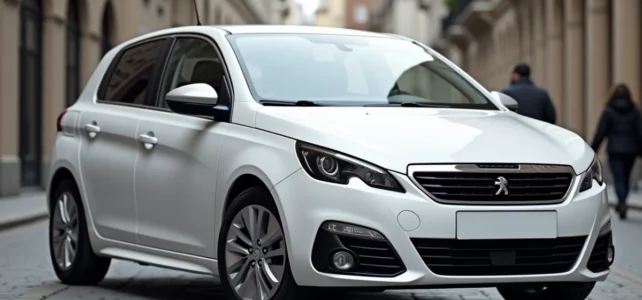
The Peugeot 308 phase 3 features a longer and lower silhouette than its predecessor. With a length of 4.37 m, a width of 1.85 m excluding mirrors, and a height of 1.44 m, this compact sedan gains presence on the road without changing its perceived size. Understanding these dimensions mainly means knowing how they affect daily life: parking, trunk loading, and rear passenger comfort.
308 Trunk: Volume Changes Depending on the Engine
Most technical specifications show a single trunk value. This can be misleading. On the 308 phase 3, the usable volume directly depends on the type of engine.
The thermal versions (PureTech petrol, BlueHDi diesel) and mild hybrids offer a trunk volume of 412 liters in sedan configuration. With the rear seats folded down, it reaches 1,323 liters. This is a generous capacity for the compact segment.
The e-308, the 100% electric variant, drops to 361 liters. With the seats flat, the total caps at 1,271 liters. The battery located under the floor takes up space, although Peugeot has minimized the loss by maintaining a relatively low loading threshold.
Why does this difference matter? If you regularly transport a stroller, a folding bike, or bulky groceries, the dimensions of the Peugeot 308 phase 3 are not just about the exterior length. The choice of engine directly influences the space available in daily use.
- 308 thermal and mild hybrid: 412 L, up to 1,323 L with seats folded
- 308 plug-in hybrid (PHEV): slightly reduced volume compared to the thermal, as the battery encroaches on the underfloor
- e-308 electric: 361 L, up to 1,271 L with seats folded
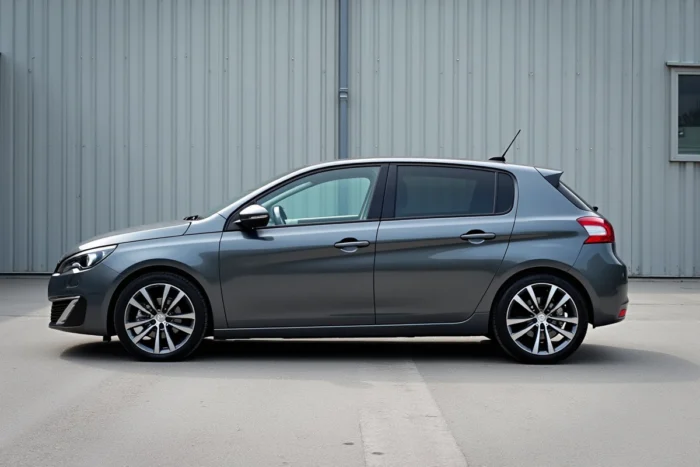
Interior Dimensions of the Peugeot 308: Elbow Width and Torso Height
The exterior dimensions don’t say much about the comfort experienced inside. What matters is the actual space for shoulders, knees, and head.
At the front (row 1), Peugeot states an elbow width of 1,443 mm and a torso height of 891 mm. The driver and passenger have generous space, even with above-average builds.
At the rear (row 2), the elbow width drops to 1,400 mm. The difference remains modest. Three adults can fit in the back seat without excessive squeezing, provided the central passenger accepts the transmission tunnel under their feet (on thermal versions).
Wheelbase: The Figure That Explains Legroom
The wheelbase of the 308 phase 3 reaches 2.67 m. This is the distance between the front and rear axles. The longer the wheelbase, the more rear knee space increases. This value places the 308 in the upper average of the C segment, on par with competitors like the Volkswagen Golf or the Renault Mégane.
In practice, a rear passenger measuring up to 1.85 m travels comfortably on a journey of a few hours. Beyond that, the slightly short seat of the bench may tire the thighs.
Peugeot 308 Sedan or 308 SW: The Dimensions That Make the Difference
The 308 is available as a five-door sedan and as a station wagon (SW). Both share the same width and wheelbase. What changes is the total length and trunk volume.
The 308 SW gains several centimeters in length compared to the sedan. This surplus translates into a significantly larger trunk on the wagon, aimed at families or professionals who load equipment.
Are you hesitating between the two? Ask yourself a simple question: how many times a month do you fold down the rear seats? If the answer is “regularly,” the wagon justifies its extra cost. If you mainly transport passengers, the sedan is sufficient and parks more easily in the city thanks to its shorter rear overhang.
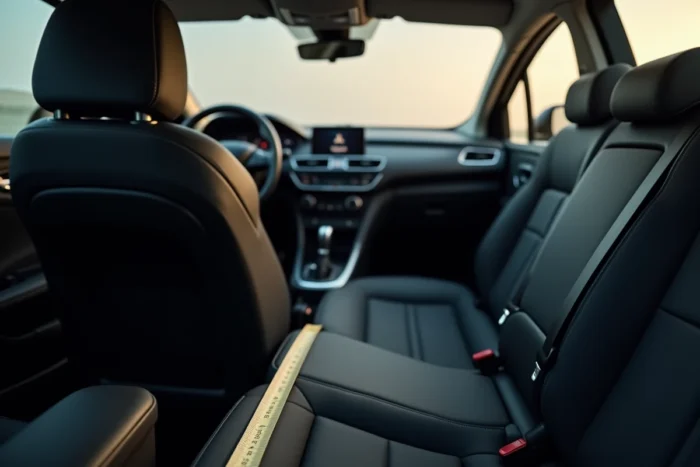
Dimensions of the 308 Phase 3: What It Changes for Parking
At 4.37 m long, the 308 remains below the symbolic 4.40 m mark. It fits into most standard parking spaces in France, which generally measure 5 m in length.
The width of 1.85 m excluding mirrors deserves more attention. With mirrors deployed, expect about 2.06 m. In a narrow underground parking lot, this total width can complicate maneuvers. Electrically folding mirrors, available depending on the trim, become a valuable feature.
The height of 1.44 m poses no issues for passing under parking barriers (the usual limit is around 1.90 m). It also contributes to the car’s aerodynamics, with a drag coefficient (Cx) of 0.28, a low value for a compact.
Turning Radius and Urban Maneuverability
The turning radius partly depends on the wheelbase. With 2.67 m between the axles, the 308 phase 3 offers decent maneuverability in the city. Parking sensors and a rearview camera (depending on trim) compensate for the lack of rear visibility, linked to the typical Peugeot design’s sloping roofline.
Weight of the 308 Depending on the Engine: From 1,203 kg to 1,633 kg
The exterior dimensions remain the same regardless of the engine, but the curb weight varies by more than 400 kg between the lightest and heaviest versions. The PureTech petrol models start at 1,203 kg. The plug-in hybrids (PHEV) reach 1,633 kg.
This weight difference affects road behavior, fuel consumption, and tire wear. A 308 PHEV puts more strain on its front tires, carrying the weight of both the thermal and electric motors combined. This is a factor to consider in the maintenance budget.
The range includes PureTech engines of 110 and 130 horsepower in petrol, BlueHDi 130 horsepower in diesel, plug-in hybrids of 180 and 225 horsepower, and the e-308 electric. Each variant retains the same exterior dimensions, with only the weight and trunk volume changing.
The 308 phase 3 manages to accommodate five occupants, a usable trunk, and several engine configurations within a compact size that does not exceed 4.37 m. The differences between versions are found beneath the body, not around it.