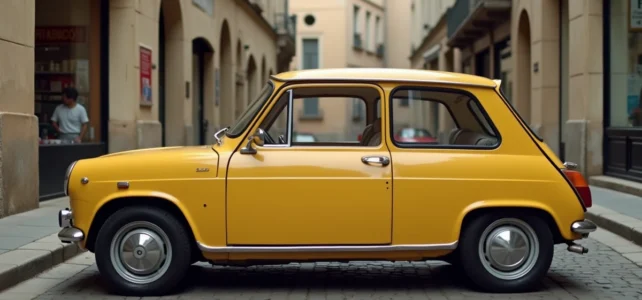
When you come across a small hatchback Renault in an ad or a garage, the first practical question is often the same: is it an R5 or a Super 5? The confusion is common because both models look alike, bear almost the same name, and share some mechanical components. However, the answer lies in very different design choices, separated by more than a decade of industrial evolution at Renault.
Longitudinal engine versus transverse engine: what really changes under the hood
On the ground, the clearest distinction between the R5 and Super 5 is not immediately visible. It is found under the hood. The R5, produced from 1972, adopts a longitudinal engine layout. The Cléon-Fonte block is positioned in line with the vehicle, with the gearbox mounted overhanging behind the front axle.
The Super 5, launched in 1984, switches to a transverse architecture. The engine is mounted perpendicular to the car’s axis, freeing up space in the cabin and profoundly altering the driving behavior. There is a gain in mechanical compactness, and rear passenger space improves significantly despite similar exterior dimensions.
For those looking to understand the difference between R5 and Super 5, this is the starting point: two distinct mechanical philosophies, even though the Cléon-Fonte block is found on both sides.
Renault 5 and Super 5 design: visual lineage, detail break
Marcello Gandini designed the body of the Super 5. His approach is reminiscent of Volkswagen’s with the Golf II: take the familiar silhouette and redesign each line. The result actually unsettled the public at launch, with many people thinking it was just a simple facelift of the R5.
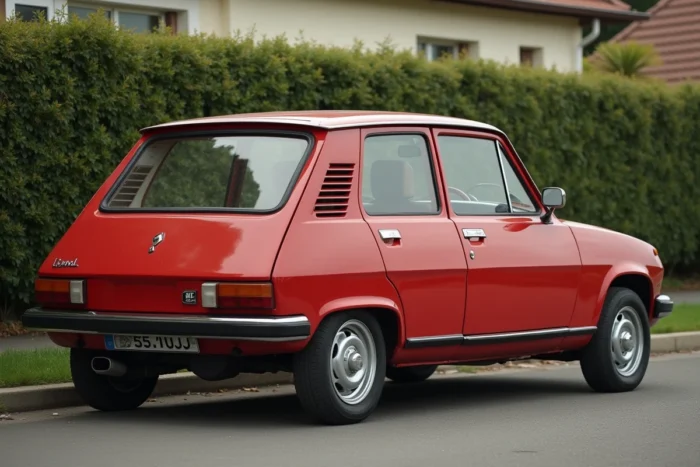
However, the differences are clear when you put the two cars side by side.
- The original R5 features rounded shapes, soft plastic bumpers integrated into the body (an innovation for the time), and a sober, almost minimalist dashboard.
- The Super 5 adopts a more angular design, with a cabin designed “in edges” and a visor over the instruments, a signature of Gandini.
- The front lights change radically: rectangular on the Super 5 phase 1, they move away from the characteristic round headlights of the R5.
- The Super 5 phase 2 (from 1987) further refines the design with redesigned bumpers and finishing adjustments.
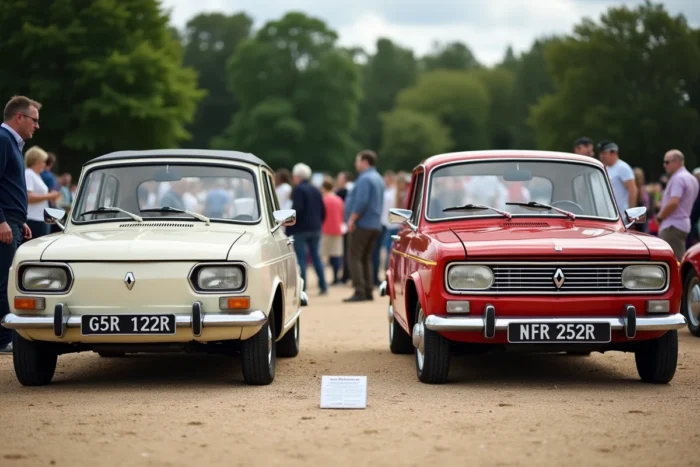
In a parking lot, the quickest way to tell them apart is to look at the headlights and the body line. The R5 has an organic curve, while the Super 5 has a tighter outline.
Sport versions: R5 Turbo and Super 5 GT Turbo, two approaches to driving
Turbo versions are often discussed as if they were interchangeable. They are not at all. The R5 Turbo (and its Turbo 2 variant) is a vehicle with a rear mid-engine, built in limited series with spectacularly widened fenders. It is a rally car homologated for the road, designed for competition.
The Super 5 GT Turbo remains a front-wheel drive. It retains the transverse architecture of the standard Super 5, with a turbo grafted onto the Cléon-Fonte block. The result is an accessible small sports car, with a chassis recognized as remarkable by specialists, but which has nothing to do with the radical temperament of the R5 Turbo.
The GT Turbo is a daily road sports car, while the R5 Turbo is a collector’s item. Current prices reflect this distinction: the R5 Turbo reaches prices unmatched by those of a GT Turbo, even in good condition.
1970s electric Renault 5: an unknown episode before the Super 5
Even before the Super 5 existed, Renault explored electric options based on the original R5. Developed with EDF in the early 1970s, this electric R5 was produced in approximately 90 to 100 units, mainly intended for administrations.
The vehicle was a two-seater: the rear bench disappeared to accommodate eight lead batteries. The weight reached about 1,020 kg when empty, with a recommended range of about 60 km and a maximum speed of 60 km/h. We are far from the performance of the current R5 E-Tech, but this episode shows that the original R5 tested electric technology long before any other generation of the model.
The Super 5 never had an electric equivalent. This historical detail is rarely mentioned in comparisons between the two generations, even though it sheds light on Renault’s trajectory towards current electrification.
Production and positioning: the Super 5 as a bridge to the Clio
The R5 was produced from 1972 to 1984. The Super 5 took over from 1984 to 1996, with a total of over 3.4 million units. This overlap with the first Clio (launched in 1990) is often overlooked.
For six years, Renault sold both the Super 5 and the Clio simultaneously. The Super 5 gradually slipped towards the entry-level segment, with diesel versions and simplified trims, while the Clio attracted customers looking for modernity. Opinions vary on this point, but for many enthusiasts, the Super 5 phase 2 remains the best compromise between the reliability of the Cléon-Fonte and everyday driving comfort.
This late positioning also explains why there are still Super 5s in decent condition at reasonable prices: the last models, produced in large numbers, never had the status of a collector’s item, unlike the early R5 TL or GT Turbo.
R5 and Super 5 share a name and lineage, but not a platform, not an engine layout, not an era. Confusing the two is like confusing a vinyl record and a CD on the grounds that they play the same song.